Brave News Worlds: Navigating the New Media Landscape, published by the International Press Institute in September 2010, ran to 152 pages and 42 essays by news executives, digital thinkers and educators. One dealt with a question newsrooms were spending money on: which online video actually works.
The essay, The Future of TV News Belongs, in Part, to Multi-Platform Video, was written by Steve Herrmann, editor of the BBC News website. His answer was the short clip that shows something visually compelling, and it worked best embedded inside the related text story: traffic to video doubled within a year of the BBC News site starting to embed it.
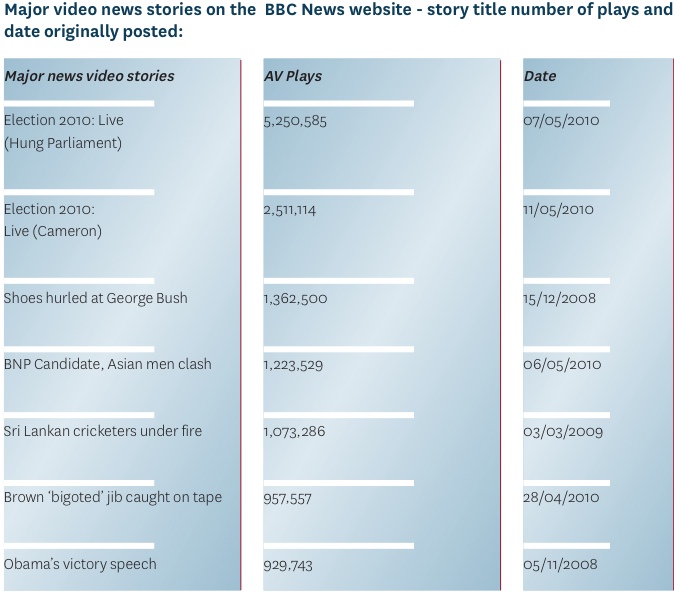
The difference was one of function. A short clip shows the story, where a television package has a reporter telling it — and online that intermediary is often redundant, because the reader has already read the story on the same page. The BBC’s own numbers were blunt: “news and sport video clips now tend to get more traffic overall than long-form news programmes” on iPlayer, and longer-form news video was “not – for now anyway – proving that compelling for news consumers online”. The site’s most-played list bore it out, topped by election night 2010 and the hung parliament at 5.25 million plays, alongside single clips of the shoes thrown at George Bush and the “bigoted woman” remark on tape.
Herrmann did not write off broadcast craft. His suggestion was to reverse the order instead: the linear broadcast becoming “a bit like a trailer” for the fuller treatment on-demand platforms have room for.